Routes we build with our own hands.
Fiber and copper routes, in-building cabling and last-mile connections — our own crews, our own equipment, from project to handover into operation.
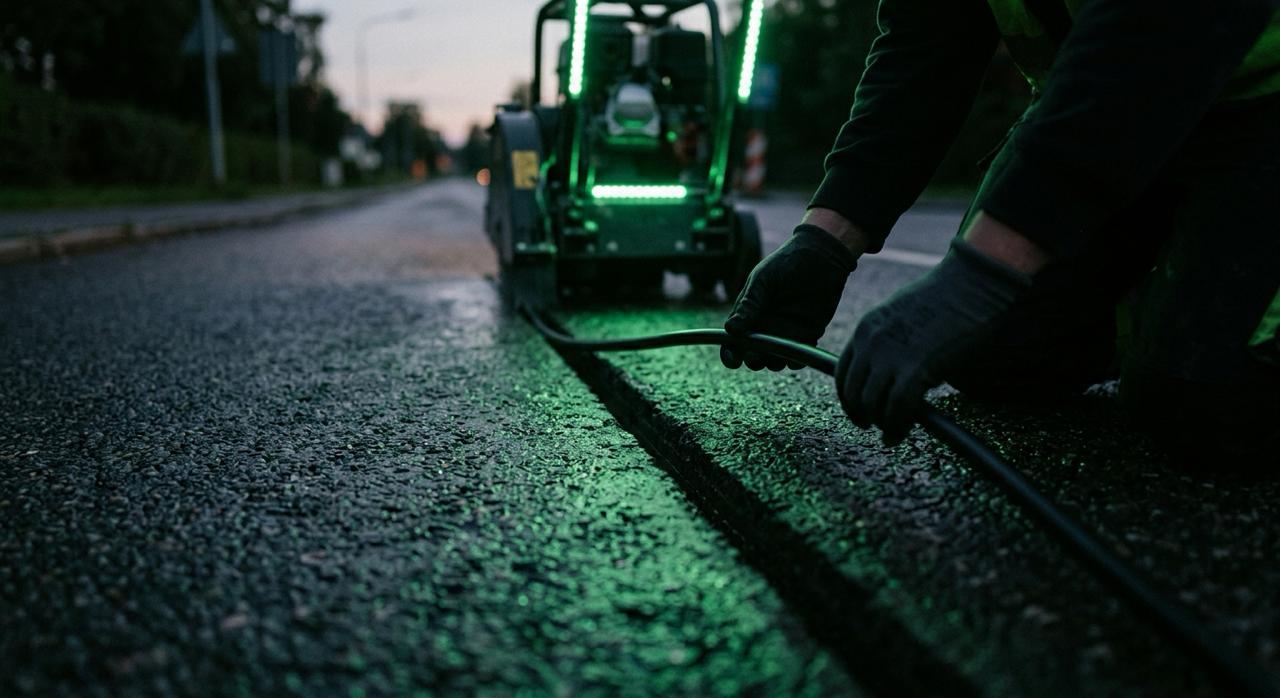
Fiber and copper routes
We build routes between buildings, municipalities and within sites — from project preparation and utility locating through excavation and duct laying to fiber blowing, splicing and route testing.
Request a build- Project preparation and utility statements
- Excavation and directional drilling
- Duct laying and fiber blowing
- Splicing, testing and reports
- Geodetic survey and as-built documentation
Structured cabling
Complete cabling for offices, production halls and apartment buildings — route design, cabinet installation, termination and patching of outlets, testing and certification of the whole network.
Request cabling- Offices and administrative buildings
- Production and warehouse halls
- Apartment buildings and development projects
- Renovation of outdated cabling
Construction subcontracting
We have spare crew and equipment capacity and build as a subcontractor for telecom operators, developers, construction companies and municipalities. We take on partial sections as well as complete builds, including responsibility for handover.
Arrange cooperation- Telecom operators
- Developers and construction companies
- Municipalities and city districts
- Smaller ISPs without their own crews
From quote request to handover
A route is built in five steps. For a standard connection the whole process takes weeks; for larger builds, months.
Survey
We walk the site and assess the conditions and possible complications along the route.
Project
We prepare the documentation and obtain statements from network operators.
Excavation
We locate utilities, excavate or drill and lay the duct.
Fiber
We blow the cable, splice the joints and test the whole route.
Handover
Geodetic survey, reports and as-built documentation.
We do not dig everywhere it makes no sense
Depending on the terrain and obstacles we choose the method that is fastest and most considerate to the surroundings.
Open trench
The cheapest method where the terrain is open and paved surfaces are not at risk.
Directional drilling
Passing under a road, pavement or driveway without breaking the surface.
Micro-trenching
A narrow groove cut into asphalt — fast, with minimal impact on the road.
Aerial lines
Mounting on poles where an underground route is impractical or disproportionately expensive.
Our own crews, our own machinery
We do not resell the work. We own the fiber splicers, test equipment and excavation machinery, so deadlines do not depend on when someone external becomes available.
Request a build- Fiber splicers and test equipment
- Machinery for excavation and drilling
- Locating equipment for utility detection
- Geodetic survey of the finished route
- Technicians certified for optical networks
Construction in practice
Do you also arrange permits and utility statements?
Yes, we handle project preparation including statements from network operators as part of the contract.
Do you build even where you are not the internet provider?
Yes. Construction is a standalone service — you do not have to be our connectivity customer.
Can you coordinate with the other trades on site?
Yes, we commonly work as a subcontractor on larger builds and adapt to the general contractor's schedule.
What do I get at handover?
Test reports, a geodetic survey and as-built documentation of the construction.